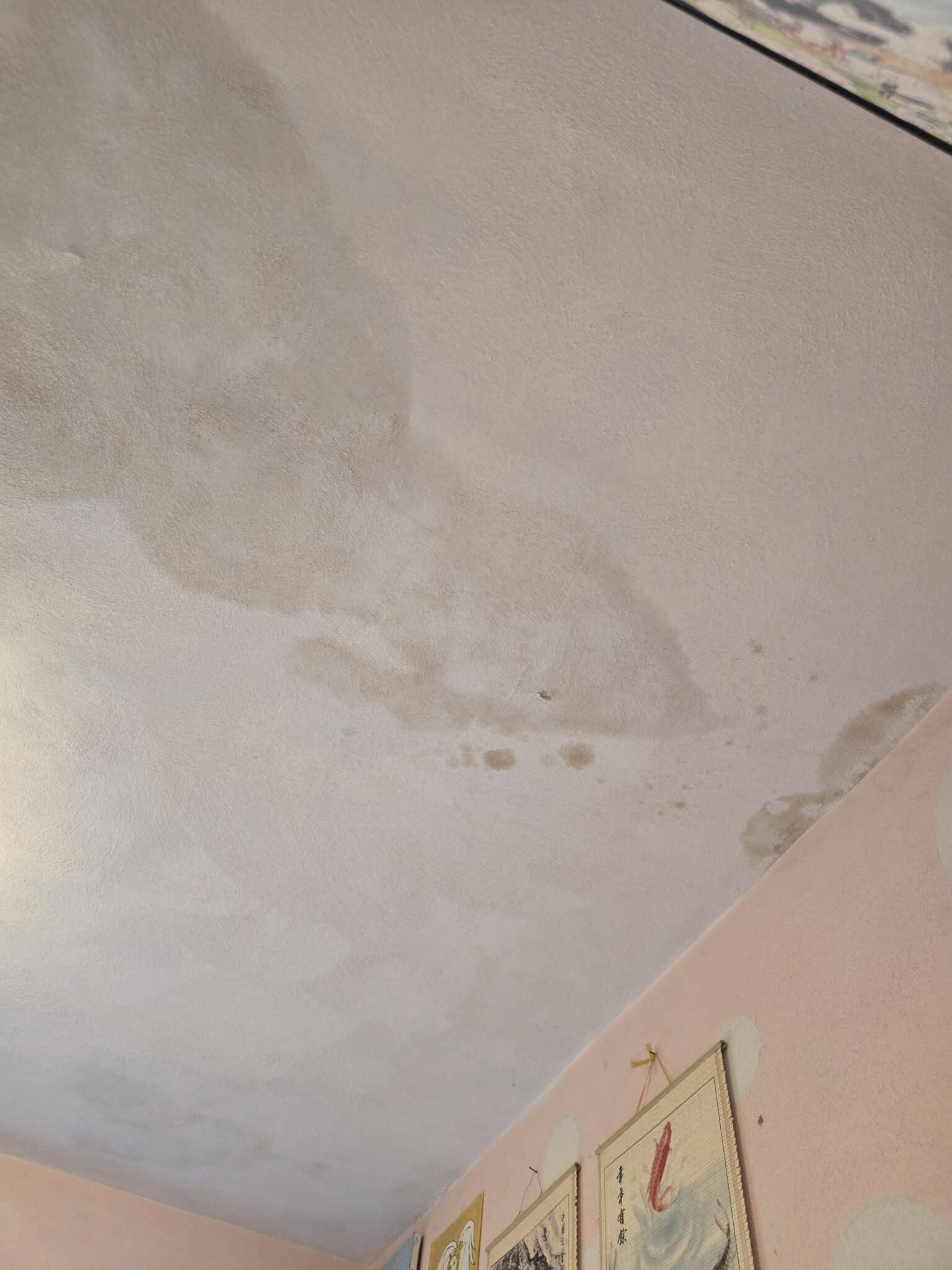
A brown ring shows up on the bedroom ceiling after a hard rain, and the first thing you wonder is how bad this is going to be. Often, less bad than you fear. Many leaks trace back to one failed spot on the roof, and many of them are a repair, not a new roof.
Roof leak repair that lasts starts with finding where the water gets in, which is often not right above the stain. Water slips past a damaged shingle or failed flashing, runs along the underlayment and the roof deck, and drips wherever it finds a way down. A proper repair traces that path, replaces the materials that failed and restores the layers underneath. Sealant smeared over the spot only covers the problem for a while.
In this article
- Why Isn’t the Stain Where the Leak Is?
- What Should You Do Right Now If Your Roof Is Leaking?
- Where Do Roof Leaks Usually Start?
- How Does a Roofer Find the Source of a Leak?
- Is a Quick Patch Enough, or Do You Need a Lasting Repair?
- When Does a Leak Mean You Need More Than a Repair?
- How Do You Choose Who Fixes Your Roof Leak?
- Roof Leak Repair FAQ
You don’t have to guess where yours is coming from. Get a Free Roof Inspection from Edwards & Sons Roofing: we come to you, no sales pressure.
Why Isn’t the Stain Where the Leak Is?
Because water travels before it drips. The stain on your ceiling marks where the water finally came through, which can be several feet from where it got into the roof.
An asphalt shingle roof is built in layers, and each one can carry water sideways:
- Shingles: the outer layer that sheds most of the rain.
- Underlayment: the sheet under the shingles that acts as a second barrier.
- Roof deck: the wood boards or panels the whole roof is fastened to.
- Rafters: the sloped framing that holds up the deck.
- Attic insulation and ceiling: where the water ends up once it drops off the framing.
Water that gets past a shingle can run down the underlayment, along the top of the deck or down the side of a rafter before it soaks through insulation and shows up on drywall. The National Roofing Contractors Association notes that where a leak appears inside doesn’t have to match where water enters, because water can move sideways first.
That’s why patching the shingles directly above a stain can miss the leak entirely.
It also explains why a small leak can go unnoticed for weeks. The water may be soaking into wood and insulation long before it reaches the ceiling, which is why a leak from summer hail sometimes doesn’t show indoors until fall.
What Should You Do Right Now If Your Roof Is Leaking?
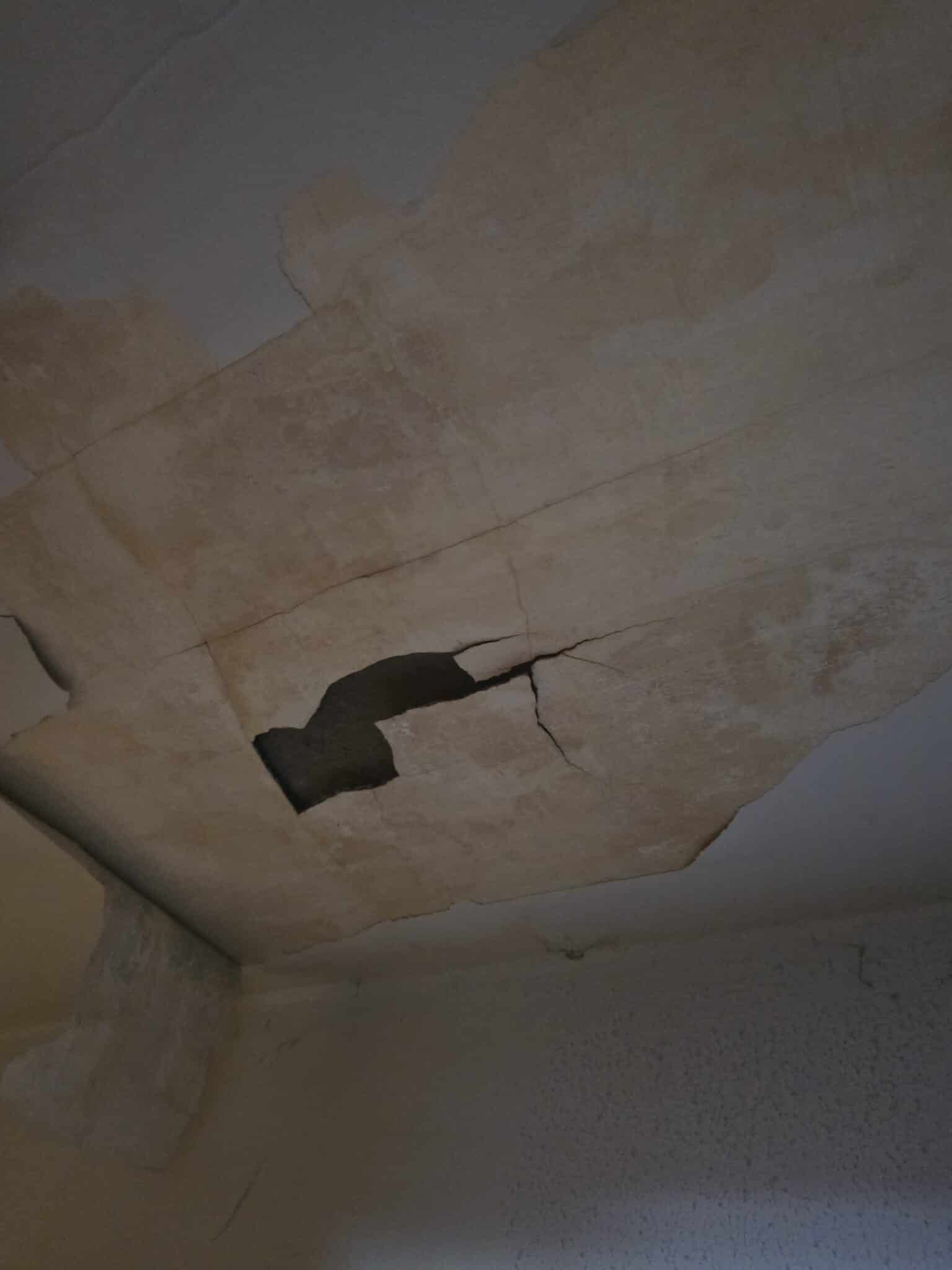
Catch the water, keep people clear of anything wet overhead or electrical, and leave the roof itself for later.
- Put a bucket or tub under the drip, with a towel in the bottom to cut the splashing.
- Keep people and pets out from under a ceiling that is sagging or bulging, and don’t puncture it yourself. It can let go a heavy rush of water, and there may be wiring above it.
- Stay away from wet switches, outlets, light fixtures and cords.
- Move furniture and belongings out of the way if you can do it without standing under the wet spot.
- Take dated photos from somewhere dry and stable, so you have a record of how it looked.
Please don’t climb up there. A wet or storm-hit roof is slippery underfoot, and soaked decking can have soft spots you can’t see from above. Buckets and towels hold things over until the weather clears, and our guide to emergency roof leak repair covers what to do before help arrives.
Where Do Roof Leaks Usually Start?
Most leaks start where the roof is interrupted, at its joints, edges and openings, rather than in the middle of a plain run of shingles. Nobody has reliable numbers on which cause is most common, so think of this as a list of places to check, not a ranking.
- Chimney and wall flashing: the metal pieces that seal the joint where the roof meets something vertical. When flashing loosens or fails, water runs straight behind it.
- Plumbing vent boots: the collar that seals around each pipe coming through the roof. Once it cracks or pulls away from the pipe, water follows the pipe down into the attic.
- Valleys: the inside corners where two slopes meet. They channel water off both slopes, so a weak spot there gets tested in every rain.
- Nail pops: a nail that backs out of the deck pushes up the shingle above it and opens a small path for water.
- Damaged or missing shingles: tabs lifted by wind, shingles cracked by hail, or pieces gone entirely.
- Ice dams: a winter problem at the lower edges of the roof, covered below.
Ice dams deserve their own note in the Midwest. They form when snow melts on the warmer upper part of the roof and refreezes at the colder eave. The water that backs up behind that ridge of ice can work under the shingles and into the sheathing and ceilings. The Building Science Corporation says ice dams are common wherever there is snowfall and at least a month of below-freezing temperatures, and it points to attic insulation and air leaks into the attic as major causes. It treats ventilation as a supplement to fixing those, not a substitute.
Storm damage doesn’t always leak during the storm. Hail can bruise or crack shingles and break their seals, and that kind of damage often doesn’t let water in until a later rain. Strong spring and summer wind can lift tabs the same way. So if a leak shows up a few weeks after a hailstorm, the storm may still be the cause, and storm and hail damage repair is worth a look.
How Does a Roofer Find the Source of a Leak?
By working from the stain back to the roof, one step at a time, and confirming the entry point before anything gets torn off.
- Start in the attic, in daylight. Look for dark stains on the underside of the deck, damp insulation, water trails down a rafter, or daylight showing through where it shouldn’t.
- Follow the trail uphill. Water runs down the slope, so the true entry point is usually somewhere above the wettest spot in the attic.
- Check the roof in that area. Every flashing detail, vent boot and shingle gets a close look, along with the valleys, where leaks often start. On many inspections we start with drone photos, which give a clear first view of a steep or high roof, and then confirm what they show up close.
- Water test when the leak won’t show itself. Even for an experienced roofer, some leaks only appear under running water, which is where advanced leak diagnostics come in. One person runs a hose over a small section of roof, starting low and working up, while another watches from the attic. When the drip starts, you know which section let it in.
That careful look is why we offer free roof inspections. We’ll always tell you what your roof actually needs, not what makes us the most money, and if the answer is a small repair, that’s what we’ll recommend. Get a Free Roof Inspection and we’ll come to you.
Is a Quick Patch Enough, or Do You Need a Lasting Repair?
A quick patch can buy you time. A lasting repair replaces what failed.
| Fix | What it does | Where it falls short |
|---|---|---|
| Tarp | Keeps rain off the damaged area until a repair | Temporary cover only; the damage underneath is still there |
| Roofing cement or caulk over the spot | May slow a small leak | Can hide the real failure and make the later repair harder |
| Spray-on coating | May slow a very small leak briefly | Can’t fix a missing shingle, failed flashing, a cracked vent boot or wet decking |
| Lasting repair | Finds the source and replaces the failed materials | Needs a proper inspection first |
Shingle manufacturer OC describes sealant and caulk as a final temporary step to help keep moisture out, not as a substitute for replacing damaged roofing materials. The trade group for asphalt shingle makers also cautions against coatings applied over shingles that are already on the roof.
There’s a practical reason for that. Cement or coating spread over a problem can hide it, so the next roofer has to dig through the patch before they can see what actually broke.
A lasting repair on an asphalt shingle roof generally goes in this order:
- Confirm the true source of the leak.
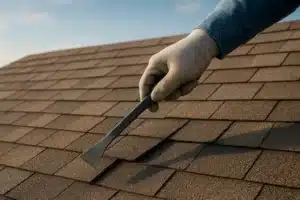
- Remove the failed shingles instead of covering them. A damaged or missing shingle can often be replaced on its own.
- Replace failed flashing or a cracked vent boot.
- Restore the underlayment, with each piece overlapping the one below it so water sheds down and out.
- Repair any deck boards that are soft or wet.
- Install matching shingles, fastened and sealed the way the manufacturer’s instructions call for.
When Does a Leak Mean You Need More Than a Repair?
Often a single leak is a repair. It becomes a bigger conversation when the roof shows age or damage in many places at once.
Signs that point beyond a repair:
- Leaks in more than one spot, or new ones showing up after the last fix.
- Heavy granule loss across the roof, to the point where the dark asphalt is showing.
- Shingle edges curling or lifting over large areas, not just one corner.
- Decking that is soft or wet across a wide section.
- Storm damage spread over most of the roof instead of one slope.
The Insurance Institute for Business & Home Safety (IBHS) explains what is going on with older shingles. Some granule loss is expected, but some products shed more over the years until the asphalt itself is exposed. The self-sealing strip that holds each shingle down also loses its grip, and IBHS says that after 7 to 10 years the sealant weakens enough to significantly reduce wind resistance. Lifted and curling tabs, in IBHS’s words, “are indicators of age.”
Our rule is to repair whenever a repair will do the job. On an old roof that is past that point, we’ll tell you plainly and explain why. When a full replacement is the right call, Owens Corning Duration shingles carry a limited lifetime manufacturer warranty.
How Do You Choose Who Fixes Your Roof Leak?
Choose a roofing contractor who inspects before giving you a number and puts the work in writing. Consumer guidance for any homeowner from the National Roofing Contractors Association, the Better Business Bureau and the Federal Trade Commission comes back to the same few checks:
- A license, where your town or state requires one.
- Proof of insurance, which any contractor should be willing to provide.
- A written estimate that names the leak source, the work to be done and the materials.
- Photos of what they found.
- Manufacturer certification for the shingles they install.
- A real inspection, on the roof or in the attic. A quote from the driveway is a guess.
Edwards & Sons Roofing has been family-owned since 1974 and is veteran-owned and operated. We’re licensed, bonded and insured, A+ BBB rated and an Owens Corning Preferred Contractor, with more than 5,000 roofing projects behind us and 140+ Five-Star Google Reviews. We handle honest roof repair and diagnostics on homes on both the Illinois and Missouri sides of the river. If you’d like us to take a look, Get a Free Roof Inspection. No sales pressure.
Roof Leak Repair FAQ
How long does roof repair take?
It depends more on finding the leak than on fixing it. Replacing a few shingles or a single vent boot can be a matter of hours once the source is clear. Soaked decking under the shingles adds work, and a repair waits for dry weather, so a stretch of rain can push it back.
Who is the best person to fix a leaking roof?
A roofing contractor, rather than a handyman or a general contractor. Swapping a shingle looks simple, but stopping a leak means knowing how the flashing, underlayment and shingles lap over one another. Get that order wrong and the water keeps finding its way in.
Will Flex Seal fix a roof leak?
It might slow a pinhole leak for a short while, but it won’t repair the roof. If you’ve already sprayed something on, tell your roofer before they start. The coating may need to come off before the real damage can be seen and fixed.
Got a stain you can’t explain? Call us at (618) 476-1480 in Illinois or (314) 896-1480 in Missouri, or Get a Free Roof Inspection and we’ll come find the source.
Get A Free Roof Inspection