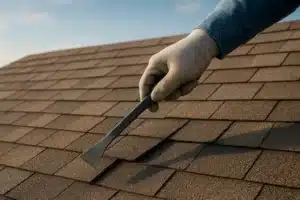
A shingle sample in your hand and that same color across your whole roof can look like two different products. You’ll live with the choice for decades, and it’s one of the few parts of a roof replacement that comes down to taste. There’s a sensible order to it, though, and it takes most of the guesswork out.
To choose roof shingle colors, start with the parts of your home you can’t change: brick, stone, siding and trim. Match warm exteriors with warm shingle blends and cool exteriors with grays and charcoal. Then check that the color suits your home’s style and any HOA rules. Heat matters less than most people expect. Before you commit, look at full-size samples outdoors at different times of day.
In this article
- Start With What You Can’t Change
- Match Shingle Color to Your Siding and Brick
- Consider Your Home’s Style
- Charcoal, Black or Brown? Choosing Among the Common Shingle Colors
- Do Light or Dark Shingles Keep a House Cooler?
- Check the Rules Before You Fall in Love With a Color
- How to See a Color on a Real Roof Before You Decide
- Can You Change the Color of Shingles You Already Have?
- Frequently Asked Questions
Start With What You Can’t Change
The right roof shingle colors are the ones that work with what’s already on your house. Your brick, stone and siding will stay put long after the new roof goes on, so they get the first vote.
Walk out to the street and look at your home the way a neighbor would. Which surface takes up the most space? On a lot of homes it’s brick or siding. On others it’s a stone front or a big stretch of trim.
Now decide whether that surface leans warm or cool.
- Warm: red, orange, tan, cream, beige and brown.
- Cool: gray, blue-gray, slate and crisp white.
Owens Corning’s color guidance comes down to a simple rule: warm shingles with warm exteriors, cool shingles with cool exteriors. It also points out a common miss. Warm-gray siding under a cool-gray roof can look disconnected, even though both are “gray.” When the siding is hard to read, look at the trim and go with whichever undertone it leans toward.
Your roof should agree with your brick. Not compete with it.
Match Shingle Color to Your Siding and Brick
The easiest way to match shingle color to your house is to pair the roof with the undertone of your brick or siding, then pick dark for contrast or mid-tone for a softer look. The pairings below are a good starting point, not a rule book. Each one names Owens Corning Duration colors worth putting on your shortlist.
| Your exterior | Shingle colors to start with | Duration colors worth a look |
|---|---|---|
| Red brick | Charcoal, gray or black | Estate Gray, Williamsburg Gray, Onyx Black |
| Tan, orange or buff brick | Brown or gray-brown blends | Driftwood, Teak, Brownwood |
| White siding | Nearly anything; black or dark gray for contrast, a lighter blend for a softer look | Onyx Black, Estate Gray, Driftwood |
| Gray or blue-gray siding | Cool grays and charcoal | Estate Gray, Sierra Gray, Slatestone Gray |
| Brown, beige or cream siding | Brown and warm blends | Teak, Brownwood, Driftwood |
A few notes on reading that table.
Red brick already brings plenty of color. A gray, charcoal or black roof lets the brick be the star. A red-toned roof on red brick tends to make the whole house read as one color.
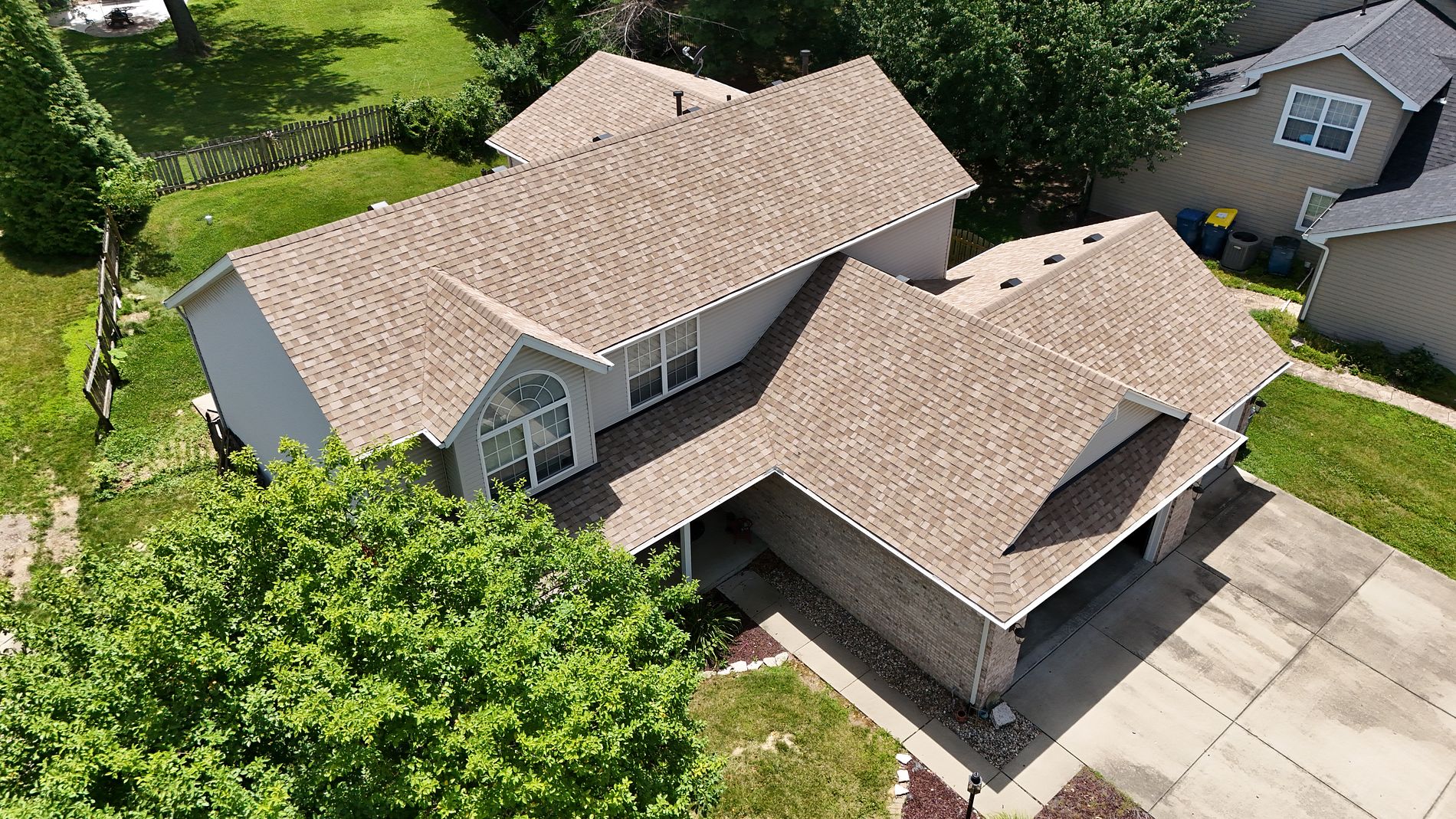
Tan and orange brick usually look best with warmer roofs. Driftwood is a lighter blend of tan, gray and brown, so it bridges warm brick and cooler trim well.
White siding is the most forgiving. A dark roof gives you sharp contrast. A mid-tone blend looks calmer.
Gray siding is where the undertone test matters most. Hold the sample right against the siding before you decide.
Brown or beige siding pairs naturally with brown roof shingle colors. If you want a bit more depth, a gray-brown blend keeps it from looking flat.
Owens Corning also makes bolder Duration colors, like Chateau Green, Harbor Blue and Terra Cotta, plus a separate Duration Designer collection with options such as Black Sable, Aged Copper and Pacific Wave. They can look sharp on the right house. They’re also harder to pair, so we’d suggest seeing a bold color on a real roof before you choose it.
One practical note: the Duration color lineup isn’t identical in every market. Ask your roofer which colors are available where you live before you get attached to one.
Consider Your Home’s Style
Your home’s style narrows the field after the color match. A shingle color that looks right on a Craftsman bungalow can look out of place on a modern build, so use style as the tiebreaker between your top two or three options.
- Traditional and colonial homes: grays, charcoal and black are neutral, classic choices and rarely look dated.
- Craftsman homes: brown and earthy blends suit the wood tones and warm palettes these homes tend to have.
- Farmhouse style: black or charcoal over white siding is the look a lot of homeowners are after.
- Modern homes: black and dark gray, often in a more uniform tone, fit the clean lines.
None of these are rules. They’re where most homes in each style end up looking their best.
Charcoal, Black or Brown? Choosing Among the Common Shingle Colors
Most homeowners end up choosing between charcoal, black and brown, and each one does a different job. Charcoal is the safe, neutral middle ground. Black gives the strongest contrast. Brown blends warm up the whole exterior.
Charcoal and gray
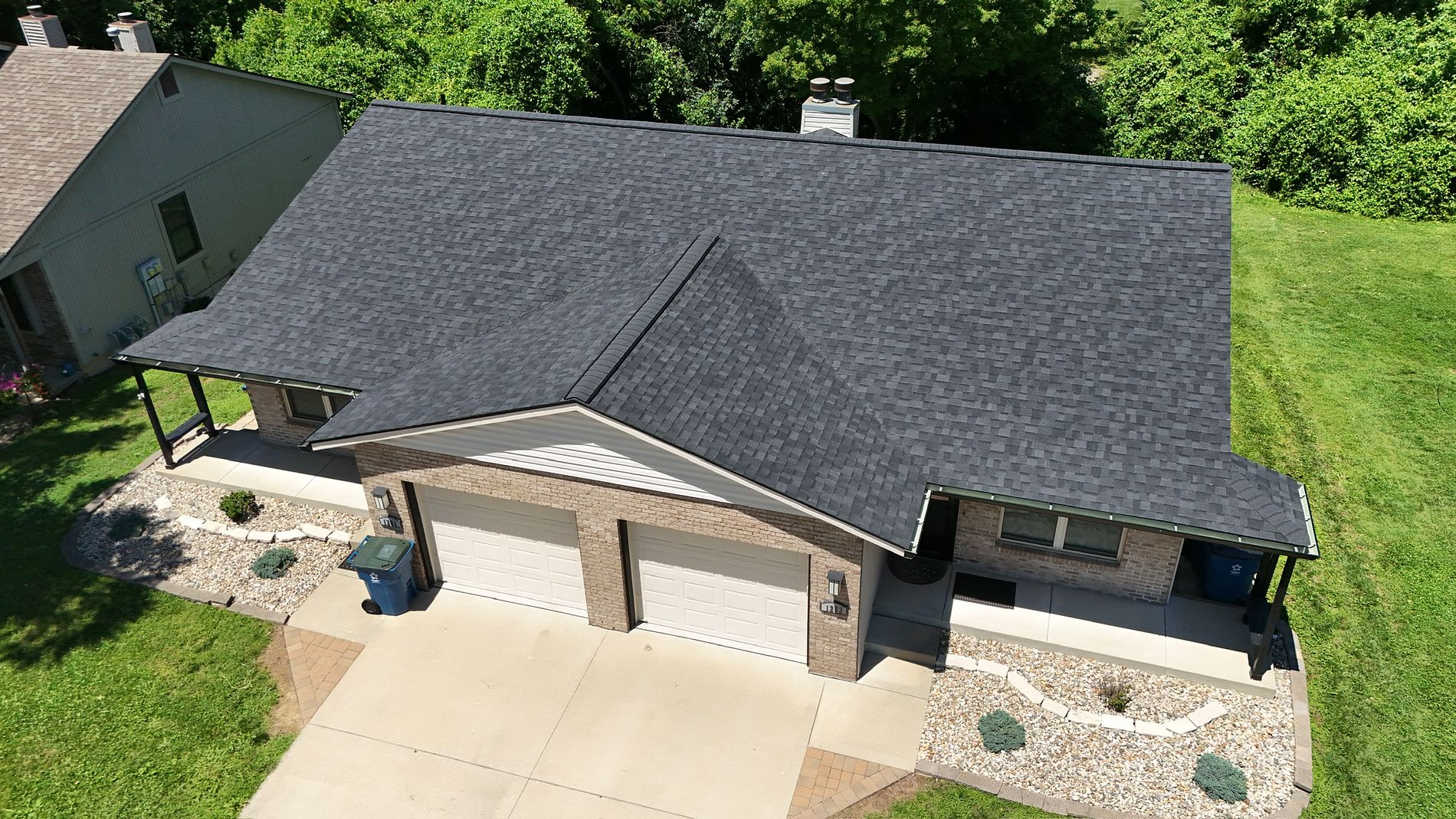
Charcoal shingle color works with almost any exterior, warm or cool, which is why it’s so often recommended. Gray blends sit a step lighter and feel a little softer next to light siding.
Black
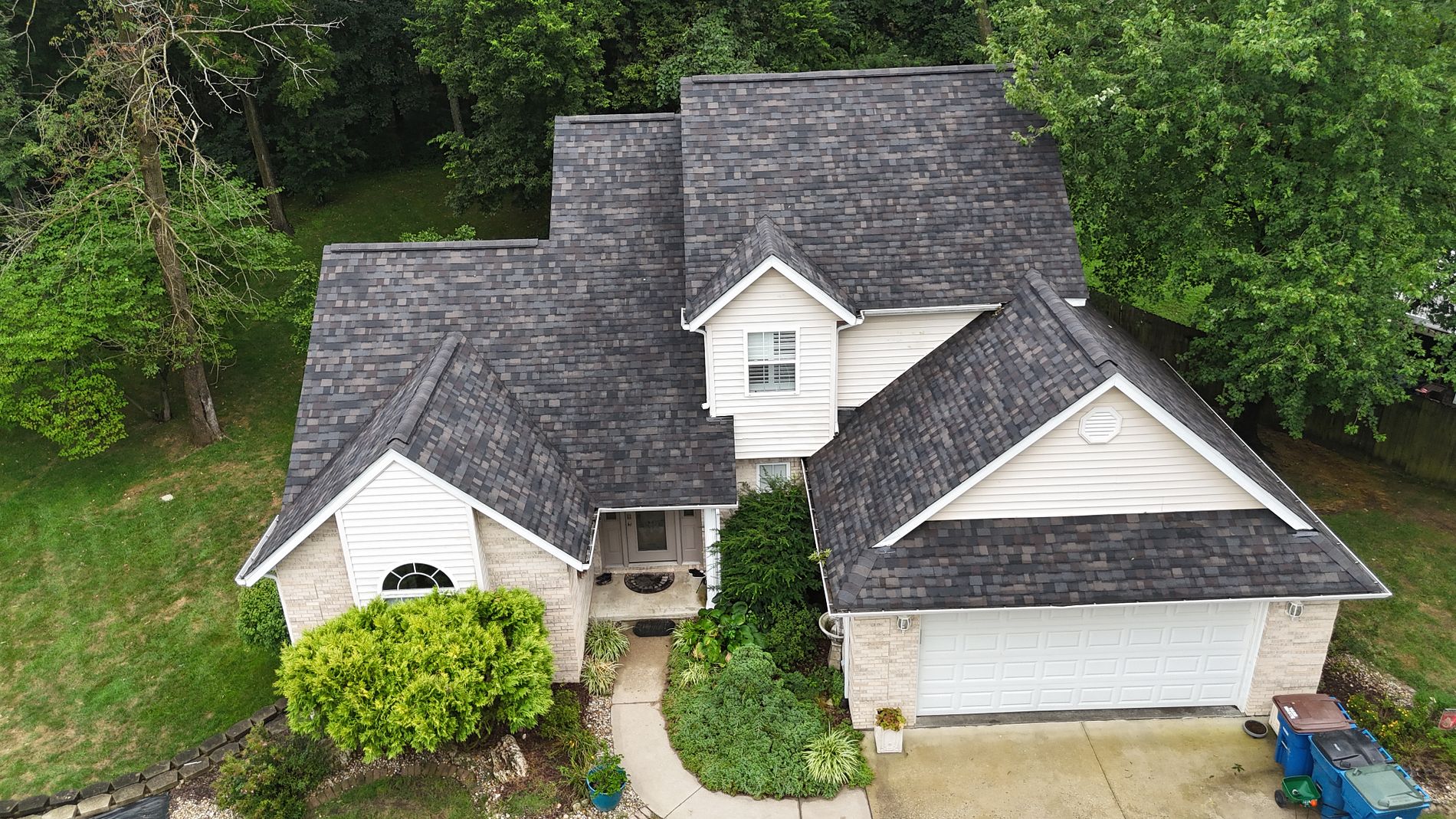
Black makes a statement, especially over white or light gray siding. Among Duration colors, Onyx Black is the most uniform, and Black Sable from the Designer collection is very dark with more tonal variation.
Charcoal versus black is a common question. On the roof, charcoal usually reads as a deep gray with some movement in it. Black reads as black. If you like the contrast but worry black will feel heavy, charcoal is the gentler version of the same idea.
Brown and gray-brown blends
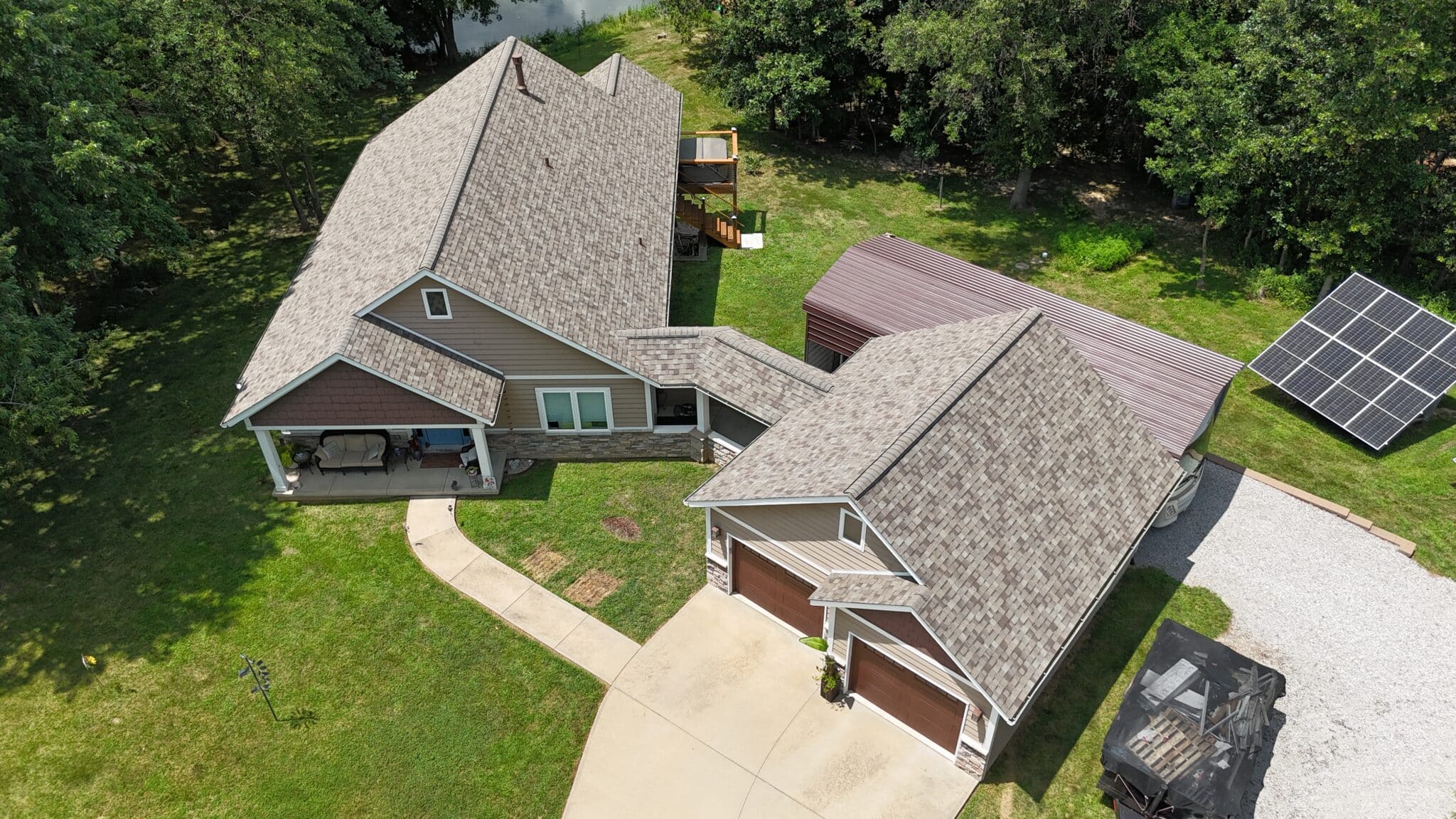
Brown roof shingle colors suit warm brick, stone and wood. The “weathered wood” look you’ll see in a lot of color galleries is a gray-brown blend; in the Duration line, Driftwood, Teak and Brownwood are the ones to look at if you like that feel.
Curb view versus up close
Architectural roof shingle colors are blends of different granule tones. Up close, a blend can look busy. From the street, it usually settles into one softer tone. That’s why you should judge a color from where people will actually see it. If you’re still weighing shingle types, our guide to 3 tab shingles covers the other common option.
Do Light or Dark Shingles Keep a House Cooler?
Light shingles reflect more sunlight than dark ones, so a lighter roof runs cooler in summer. On a whole house, though, the difference from switching shingle colors is modest, and insulation and attic ventilation matter at least as much.
Here’s what the numbers say. The U.S. Department of Energy reports that most dark roofing materials reflect only 5 to 20 percent of sunlight, while light-colored materials typically reflect 55 to 90 percent. Those figures cover roofing materials in general, not asphalt shingles specifically.
For shingles, an older field study from Lawrence Berkeley National Laboratory found that cool-colored shingles ran about 5°F cooler at solar noon than conventional ones, with about 15 percent less heat flowing through a west-facing roof. It comes from one measurement on one roof, though, not a promise about your energy bill.
The St. Louis area has hot summers and cold winters, and that cuts both ways. The Department of Energy notes that a roof that stays cooler in summer also gains less heat in winter, though that winter penalty can be smaller than the summer benefit. A darker roof isn’t a mistake here. A lighter one isn’t a magic fix either.
One more thing worth knowing: a light color isn’t the same as a cool roof. Lawrence Berkeley National Laboratory notes that some products sold as white still absorb most of the sunlight that hits them. What matters is a product’s solar reflectance and thermal emittance, which the Cool Roof Rating Council measures and rates. If heat is a big concern for you, ask about those ratings instead of going by the color name.
For most homes, pick the color you love. Then make sure the attic is insulated and vented properly.
Check the Rules Before You Fall in Love With a Color
If you live in a neighborhood with a homeowners association, check its rules before you choose a color. Many HOA covenants limit roof colors or require approval before work starts, and local rules can apply too.
Ask for the approved color list, or submit your top choice by name. Get the approval in writing before your shingles are ordered. It’s a short step that saves a lot of frustration.

How to See a Color on a Real Roof Before You Decide
The only reliable way to judge an asphalt shingle color is to see it at full size, outdoors, in your own light. Screens and printed brochures get you close, but not all the way.
Here’s the order we’d suggest:
- Start with a preview. Owens Corning’s roof visualizer lets you upload a photo of your house and try different shingle colors on it. Treat it as a way to narrow your shortlist. Lighting and roof pitch both change how a color looks, so the screen version won’t be an exact match.
- Look at several full shingles outdoors. One small chip can’t show you how a blend repeats across a roof. Look at a few full shingles side by side, against your brick or siding.
- Check them at different times of day. Morning light, midday sun and evening shade can make the same color look warm, washed out or nearly black.
- Find a real roof with a similar pitch. Pitch changes how much of the roof you see from the street. If a neighbor has the color you’re considering, look at it from the curb.
- Ask your roofer for sample boards. Contractors can often bring physical samples so you can see them against your own home.
If you’d like help narrowing it down, we’re glad to come take a look. Get a Free Roof Inspection. We come to you, no sales pressure.
Can You Change the Color of Shingles You Already Have?
Not safely. Replacing the roof is the clean way to change your shingle roof colors, and painting or coating existing shingles causes more problems than it solves.
The Asphalt Roofing Manufacturers Association strongly advises against applying any type of coating or rejuvenator to shingles after installation. Its list of possible problems includes curling or cupping, loosened granules and trapped moisture. A coating can also affect the shingles’ fire classification, algae resistance and impact resistance.
The warranty is the other concern. Owens Corning says applying a coating or rejuvenator can void its shingle warranty.
If your current roof only needs a repair rather than a replacement, though, the color question may never come up. When a repair will do the job, that’s what Edwards & Sons will recommend. Period. If a repair is enough, ask about matching the existing shingles as closely as possible.
Frequently Asked Questions
What color should my shingles be?
When two colors both pass the undertone test, think about contrast. A dark roof over light siding gives your home a crisp, defined look. A mid-tone blend is softer and tends to hide the line between roof and walls. Neither is wrong; it depends on whether you want the roof to stand out or blend in.
What is the darkest shingle?
The darkest color in the lineup we install is Onyx Black. Driftwood sits at the other end as a much lighter weathered blend. How dark a roof looks also depends on the light and the pitch, so even Onyx Black can read a little lighter on a low roof in bright sun.
What is the most popular roof color for 2026?
Charcoal and gray-brown “weathered wood” style blends are the colors 2026 roundups mention most, with black gaining ground on modern and farmhouse homes. Those lists are editorial picks, not sales figures. No manufacturer publishes sales by color.
Do dark roofs fade or show algae more?
Dark color doesn’t cause algae, but the dark streaks algae leaves behind stand out more against dark granules. Algae-resistant shingles are made for exactly this. As for fading, we found no evidence that dark shingle colors fade faster than lighter ones.
Does shingle color affect the warranty?
No. Owens Corning Duration shingles carry a limited lifetime manufacturer warranty, and the color you choose doesn’t change that. Algae-resistance coverage is a separate matter and applies only to products labeled algae-resistant. Full replacements with Owens Corning Duration shingles also include a 10-year Owens Corning Preferred Protection limited warranty.
Does roof color affect resale value?
No one publishes reliable data on how a roof color affects resale value. A color that suits your home’s brick, siding and style is the safest choice for curb appeal, whether you plan to stay twenty more years or sell next spring.
Get A Free Roof Inspection