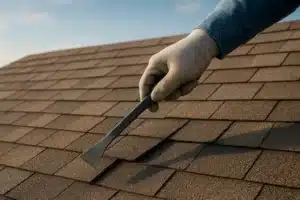
Storm damage siding repair usually starts with a homeowner in the yard the morning after, coffee in hand, looking hard at the side of the house that took the wind. Some marks are plainly visible. Others you can’t be sure about, and you’re left wondering whether that’s damage or just dirt.
Hail and wind damage to siding shows up as cracked, chipped, dented, loose, buckled or missing panels, usually concentrated on the side of the house that faced the storm. You can check most of it safely from the ground, without a ladder. Photograph what you find before anything is cleaned up, call your insurance company if you plan to file a claim, and have the siding inspected. A few damaged panels can often be repaired rather than replaced.
In this article
- What Does Hail Damage Look Like on Siding?
- What Does Wind Damage Look Like on Siding?
- What Can You Safely Check From the Ground?
- Why Can a Small Crack in Siding Still Matter?
- What Should You Do First After a Storm Damages Your Siding?
- Is Siding Repair Enough, or Do You Need Siding Replacement?
- How Does a Siding Insurance Claim Work, and Where Do We Fit In?
- What Happens During a Free Inspection With Edwards & Sons?
- Frequently Asked Questions
What Does Hail Damage Look Like on Siding?
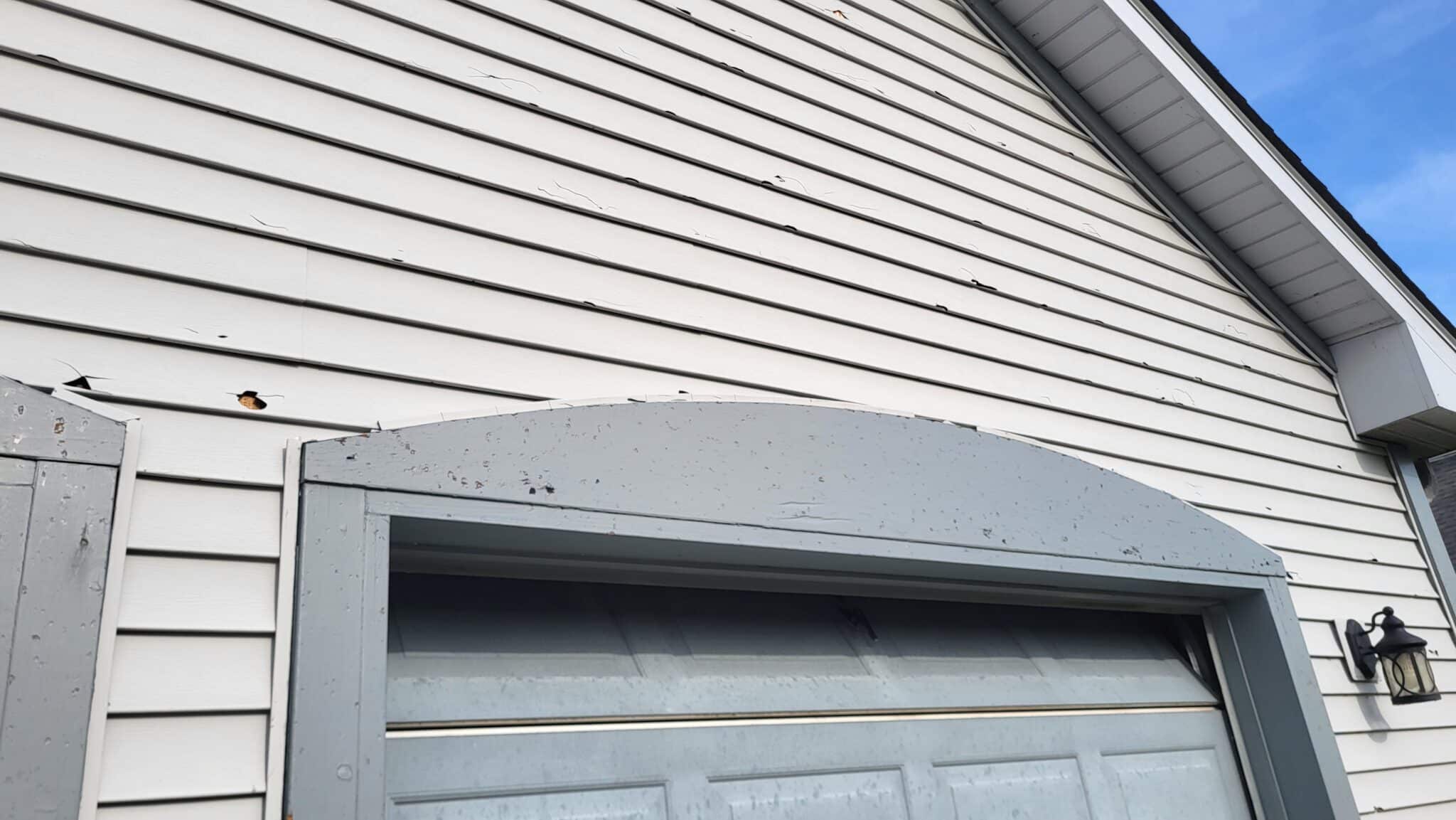
Hail damage on siding looks like scattered impact marks, round or oval, with no pattern to them, and most of them on the wall that faced the storm.
Why one side? Hail doesn’t always fall straight down. The National Weather Service’s National Severe Storms Laboratory explains that when surface winds are strong, hail falls at an angle, sometimes nearly sideways, and that wind-driven hail can tear up siding on houses. So one wall can look rough while the opposite wall looks untouched.
What the marks look like depends on your siding material:
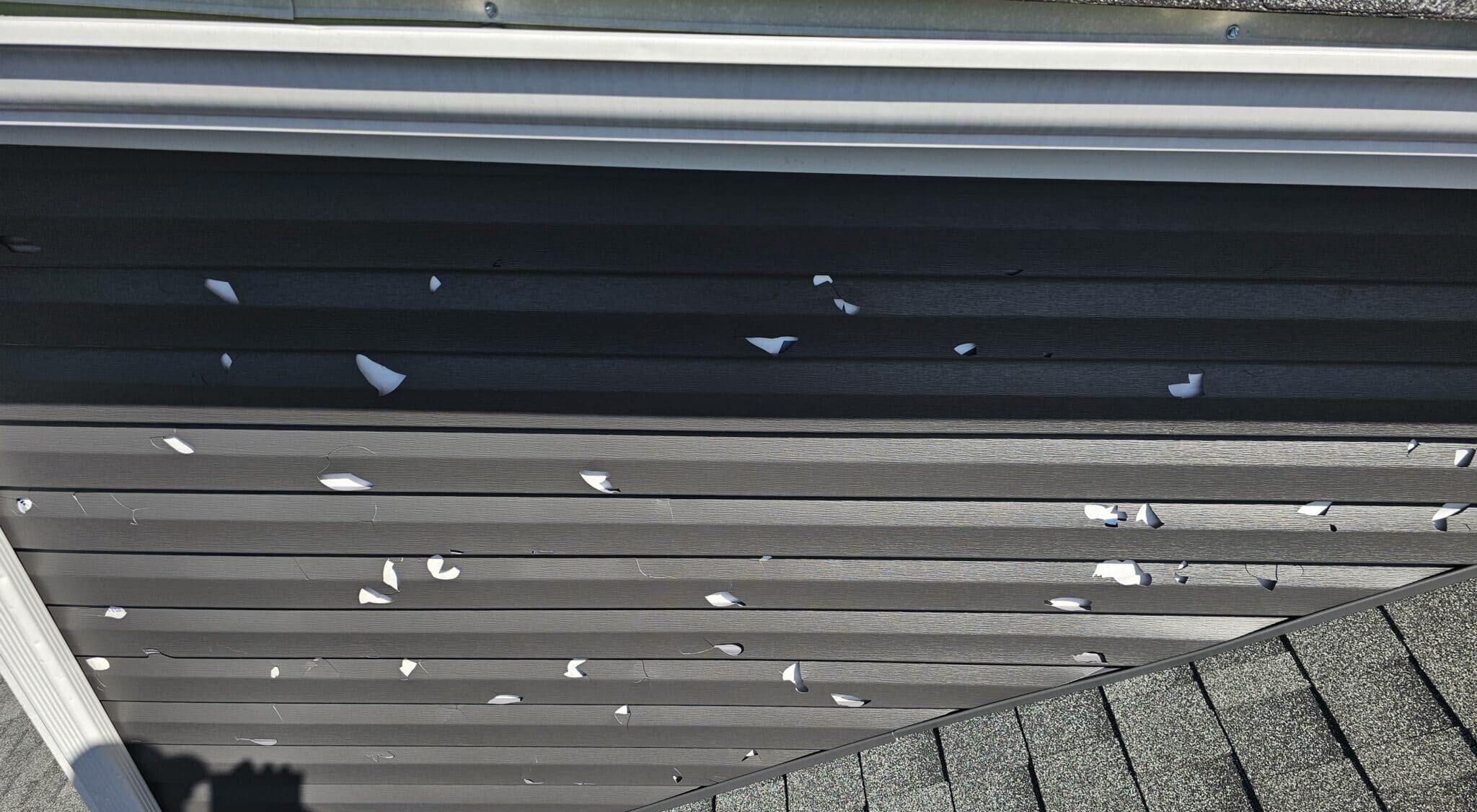
- Vinyl siding: cracks, splits, chips and small punctures. A crack can be thin enough that you only catch it when the light hits the panel at an angle.
- Aluminum siding: dents and dings, sometimes with the painted finish chipped off at the point of impact.
- Fiber cement and other materials: the same pattern to look for. Random marks, heavier on the storm-facing wall, and any spot where the surface has broken.
How big does hail have to be? There’s no single answer. NOAA’s storm lab classes hail 1 inch across (about the size of a quarter) or larger as severe, but it gives no minimum size for siding damage. As a rough guide, hail around 1 inch can start to damage vinyl, and hail of 1.5 to 2 inches is much more likely to crack or puncture it. That’s a rule of thumb. The age and condition of the siding, how cold it was, how hard the hail was and how much wind drove it all change the result.
Look at the window screens, the gutters and the downspouts on the same side, too. Fresh dents there are a good clue that the siding near them took hits as well.
What Does Wind Damage Look Like on Siding?
Wind damage looks different from hail. Instead of small impact marks, you’re looking for panels that have moved: loose, lifted, buckled, cracked or missing pieces.
On lap vinyl siding, wind can unlock the seams where one panel hooks into the next. The panel may look almost normal from a distance but sit a little proud of the wall, or flap when the wind picks up.
Wind damage tends to start at the edges of a wall, where the air has something to grab:
- Outside corners and corner trim
- Along the roof line and under the eaves
- Around windows and doors
If a panel is missing completely, look at what’s showing underneath. Housewrap or wall sheathing visible through the gap means the wall has lost its first layer of protection from rain.
Debris counts too. Wind-blown branches can damage the roof cover, siding and windows, according to the Insurance Institute for Business & Home Safety. If a limb came down against the house, look for gouges, cracks and crushed panels where it hit.
What Can You Safely Check From the Ground?
You can check most storm-damaged siding from the ground, by walking around the house and looking. No ladder, no climbing and no pulling on anything.
Start once it’s light out and the storm has fully passed. Stay well clear of downed power lines and anything that looks unstable. Then work your way around the house, one wall at a time:
- Stand back first. From across the yard, look at each wall as a whole. Wavy lines, a panel sitting out of line or a gap in the pattern are easier to spot from a distance.
- Walk in closer. Look for cracks, holes, dents, chips and open seams. Low sun or a flashlight held at an angle helps hail marks show up.
- Check the edges. Corners, trim, the area around windows and doors, and the soffit and fascia under the roof line.
- Look at the gutters and the roof edge. Dented gutters or shingle granules piled at the bottom of a downspout tell you the storm was hard enough to check the roof as well.
- Go inside. On the walls behind any damaged area, look for damp spots, stains or a draft you didn’t notice before.
- Take photos as you go. A wide shot of each wall, then close-ups of each mark.
And a few things not to do. Don’t climb a ladder to get a closer look. Don’t pull, push or snap a loose panel back into place, because you can crack it or tear what’s underneath. And don’t try to pry a panel off to see behind it.
A pair of binoculars helps with the high spots. If something up high is out of reach from the ground, that’s what the inspection is for.

Why Can a Small Crack in Siding Still Matter?
A small crack matters because siding is the first layer that keeps rain off the wall, and water that gets past it can reach the parts of the wall you can’t see.
Behind the siding sits a weather barrier (the housewrap), then the wall sheathing, then insulation and framing. Siding is built to shed most water before it gets that far. A cracked, punctured or missing panel gives rain a way in. When water gets behind the siding again and again, or gets trapped there with no way to dry out, it can soak the sheathing and lead to rot and mold over time.
That’s why a crack the size of your thumb is worth a look. It isn’t a reason to panic. It’s a reason to find out how much water, if any, has gotten in.
What Should You Do First After a Storm Damages Your Siding?
Make sure everyone is safe, document the damage before you clean anything up, and then decide whether to file a claim and get an inspection. In that order.
- Safety first. If the house itself took damage, FEMA advises confirming the electricity and gas are off before you go in to look around.
- Photograph and video everything before cleanup. FEMA’s guidance is to document damage with photos and video before you throw anything away or clean up. Get the siding, the debris in the yard and anything damaged inside.
- Keep your receipts. FEMA also advises keeping receipts for any repairs.
- Read before you sign. FEMA advises talking to your insurance adjuster or insurance company before you sign any cleaning, remediation or maintenance agreement.
- Call your insurance company if you plan to file a claim.
- Get the siding inspected by a licensed contractor you trust.
Storms are a regular part of life around St. Louis and the Metro East. The National Weather Service office in St. Louis reviewed significant severe-weather events on March 14, April 2, April 20 and May 16 in 2025 alone, with tornadoes, large hail and damaging winds among them.
Is Siding Repair Enough, or Do You Need Siding Replacement?
Often a repair is enough. If a few panels are damaged, the rest of the siding is in good condition, and a close match is available, replacing those panels is usually the sensible fix.
That’s how we look at it, too. At Edwards & Sons, we recommend siding repair over full replacement whenever possible. We’ll tell you what your siding actually needs, not what makes us the most money.
Matching is the big question with any damaged siding repair. The goal is the same manufacturer, the same profile (the shape of the panel), the same exposure (how much of each row shows) and the same color. When the exact product has been discontinued, a close profile can often be found. When there isn’t a close match, replacing a whole wall, from one corner to the next, often looks better than patching mismatched panels into the middle of it.
A larger siding replacement starts to make more sense when:
- The damage is spread across several walls, not one or two areas.
- The siding is old, brittle or badly faded, so new panels won’t blend in and the old ones crack when they’re handled.
- Water has gotten behind the siding and the wall underneath needs work.
- The profile you have is no longer made and nothing close is available.
If new siding does turn out to be the answer, energy efficient siding is worth a look, and select Mastic by Ply Gem siding carries a lifetime limited manufacturer warranty. That warranty is the manufacturer’s, not ours.
Either way, repair or replace comes down to what the inspection finds on your house.
How Does a Siding Insurance Claim Work, and Where Do We Fit In?
A siding insurance claim generally follows the same few steps: you report the damage, an adjuster from your insurance company inspects it and writes an estimate, a contractor writes an estimate for the repair, and the two are compared. If hidden damage turns up once the work starts, such as wet sheathing behind a cracked panel, it can be added to the claim later. That later addition is often called a supplement.
The details vary by insurance company and by state, and the decisions about your claim are made between you and your Insurance Company.
Here’s where we come in. Our part is to work directly with your Insurance Company and help you through the claim. When we inspect storm-damaged siding, we document what we find with photos, and drone shots where they help, so you have a clear record of the damage on every wall. We’ll walk you through what we found and what it means for the repair.
What we won’t do is promise you how a claim will turn out. We only make promises we keep.
What Happens During a Free Inspection With Edwards & Sons?
We come to you, with no sales pressure. We’ll look at the siding wall by wall, check the trim, gutters and roof edge while we’re there, and tell you plainly what we see.
Storm damage rarely stops at one part of the house. The same hail that cracks vinyl siding can dent gutters and bruise shingles, so we look at the whole exterior and tell you which parts need work and which don’t. If the siding only needs a few panels, that’s what we’ll tell you. If it doesn’t need anything, we’ll tell you that too.
Edwards & Sons Roofing has been family-owned since 1974. We’re veteran-owned and operated, A+ BBB rated, and licensed, bonded and insured, with 140+ Five-Star Google Reviews.
If you’ve walked your house and found something you’re not sure about, get a free inspection. Call (618) 476-1480 in Illinois or (314) 896-1480 in Missouri, and we’ll set up a time to come take a look.
Frequently Asked Questions
What does hail damage on siding look like?
The giveaway is the pattern. Hail leaves random round or oval marks, so a sharp crease, a straight scratch or a single dent at mower height usually points to something other than hail. Vinyl is also more likely to crack or split from hail in cold weather, when the material is stiffer.
What happens if rain gets behind siding?
One soaking doesn’t always cause lasting harm, and a wall that gets a chance to dry out may be fine. The trouble comes when water keeps getting in. Inside the house, a water stain doesn’t always sit right behind the damaged panel, because water can run down or sideways inside the wall before it shows. So a stain in one room can come from a crack a few feet away.
What should I do if my house is damaged by a storm?
Look past the siding. Hail and wind that damage siding often damage the roof and gutters in the same storm, so note any missing shingles, dented gutters or bent downspouts along with the walls. If you were told to leave your home during the storm, the National Association of Insurance Commissioners advises not going back until local authorities say it’s safe.
Does a contractor work with my insurance company?
Many do, but the claim stays yours. The National Association of Insurance Commissioners advises filing a claim directly with your insurance company, and it notes that you are not required to sign an assignment of benefits (a contract that hands your claim rights to someone else) to have repairs done.
Get A Free Roof Inspection