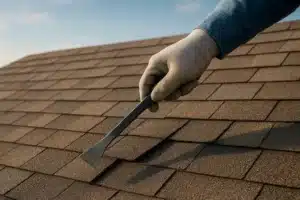
When hail strikes your roof, it doesn’t just leave a dent—it compromises the protective layer that keeps your home dry. Understanding what happens during a hail impact helps you recognize damage early, know when to call a professional, and protect yourself before the next storm.
What Happens When Hail Hits an Asphalt Shingle
Asphalt shingles are engineered to withstand wind, rain, and UV exposure, but hail is different. When a hailstone impacts a shingle, it transfers concentrated energy to a small area. That impact bruises the asphalt, dislodges the protective granule coating, and can crack or fracture the fiberglass mat underneath.
The damage isn’t always obvious from the ground. A shingle might look intact from your driveway but have internal fractures or missing granules on top. This hidden damage is what catches homeowners off guard—they don’t notice the problem until rain finds its way inside weeks or months later.
The Three Stages of Hail Damage to Shingles
Stage One: The Granule Loss
Asphalt shingles are surfaced with ceramic granules—tiny, sand-like particles that protect the asphalt from UV rays and weathering. When hail strikes, these granules are knocked loose and often fall to the ground. A single large hailstone might dislodge granules across a 2–4 inch area; a severe hail storm can strip granules from entire roof sections.
Once granules are gone, the underlying asphalt is exposed. It begins to oxidize and deteriorate much faster than it would under normal conditions. Bare asphalt also reflects less water, making it more susceptible to ponding and ice dam formation in cold climates.
You’ll notice granule loss if you find sand-like debris in your gutters or driveway after a storm. Some homeowners vacuum their gutters post-storm and discover a layer of granules—a clear sign of impact damage.
Stage Two: The Bruise and Fracture
Below the granule surface, hail creates a bruise in the asphalt itself. The material is compressed and often shows a visible indentation. In larger hailstones or harder impacts, the asphalt can actually crack or fracture, especially if the shingle was already aged or brittle from sun exposure.
A bruised or cracked shingle can split open under the stress of wind, temperature swings, or foot traffic. Once the seal breaks, water finds a path underneath the shingle and into your roof deck. This is where the real trouble begins.
Stage Three: Water Infiltration
The final stage is the consequence—water works its way under damaged shingles, into the plywood or OSB (oriented strand board) roof deck, and down into your attic or ceiling cavity. If water reaches wood framing or insulation, it stays trapped. Over weeks and months, this moisture causes the wood to soften, promotes mold growth, and can lead to structural rot that costs thousands to repair.
By the time a homeowner notices a water stain on the ceiling or feels soft spots in an attic, the damage has usually been present for weeks. Early detection of shingle damage makes all the difference.
How Hailstone Size Affects Damage Severity
Hail damage scales with hailstone size. The National Weather Service classifies hail by diameter:
- Pea to marble size (0.25–0.5 inches): Minimal shingle damage; mainly cosmetic granule loss. Most homeowners don’t notice.
- Dime to quarter size (0.75–1 inch): Moderate damage; visible bruising and granule loss on south and west-facing slopes (which take the brunt of sun and wind).
- Golf ball size and larger (1.75+ inches): Severe damage; deep cracks, punctures, and widespread granule stripping. Entire roof sections may need replacement.
Hailstones don’t all fall straight down—wind and storm dynamics push them at angles, so south and west-facing roof slopes typically see more impact than north-facing areas. The angle of your roof also matters: steeper roofs shed hail more quickly, while low-slope or flat roofs are more vulnerable to hail sitting and rolling, which compounds damage.
Why Some Shingles Damage and Others Don’t
Not every hailstone damages every shingle it hits. Several factors influence whether impact results in damage:
Age of the shingle: New shingles are more flexible and elastic—they absorb impact better. Shingles that are 10+ years old become brittle from sun exposure and temperature cycling, making them far more prone to cracking under hail impact. A roof that’s already nearing the end of its lifespan can sustain severe damage in a moderate hail event; a newer roof might walk away with only cosmetic marks.
Shingle quality and composition: Premium shingles use impact-resistant designs and tougher asphalt blends. Budget shingles are more vulnerable. The thickness and density of the fiberglass mat also play a role—thicker mats distribute impact energy better than thin ones.
Underlying roof deck condition: If the roof deck is soft, rotted, or uneven, it acts like a trampoline—the hailstone transfers more energy into the shingle instead of the impact being absorbed and dissipated. A solid, well-ventilated deck provides better protection.
Angle and velocity of impact: A hailstone falling straight down from 20,000 feet at terminal velocity will do more damage than one traveling at an angle. Wind patterns, updrafts in the storm, and local topography all affect how hail actually hits your roof.
Visible Signs of Hail Damage
After a hail storm, look for these indicators:
- Bruises or indentations on shingles, often in a speckled pattern across the roof. These look like someone hit the shingles with a hammer but didn’t break through.
- Missing or bald spots where granules have been stripped away, leaving dark asphalt exposed.
- Cracked or split shingles, especially along the edges or corners. You might see the splits only from the side angle.
- Granules in the gutters and downspouts after the storm, often appearing in quantity.
- Dented flashing or metal components around vents, chimneys, and fascia—a sign that hail was severe enough to damage harder materials.
From the ground, hail damage can be hard to spot. This is why a professional inspection matters. A trained eye can identify bruising and micro-fractures that don’t show up in photos but will fail over time.
The Insurance Claim and Hail Damage Documentation
Hail damage is often covered under homeowner’s insurance, but the insurer needs proof. Here’s what matters for a successful claim:
Documentation begins immediately after the storm. If you suspect hail damage, take photos of your roof from the ground (if safe), your gutters, and any debris. Document the date, time, and type of storm.
A professional roof inspection is critical. Insurance adjusters expect to see evidence of impact damage on the roof itself. An inspector who understands insurance documentation can highlight damage patterns that prove hail impact rather than normal wear.
The adjuster will compare damage to the the storm track. If hail did fall in your area but your roof shows no damage while neighbors’ roofs are clearly hit, the claim is easier to approve. If you report damage but can’t show visible impact marks, the adjuster may deny the claim.
This is where professional involvement makes a difference. Contractors who work regularly with insurance companies know how to photograph and document damage during the adjustment process.
What Happens Next: From Damage to Leaks
Hail damage doesn’t always mean immediate leaks. In fact, many hailed roofs don’t leak for weeks or even months. But the damage is progressive:
- Impact creates weak points in the shingle structure.
- Weather exposure accelerates deterioration—wind flexes the damaged shingles, rain finds micro-cracks, UV rays break down the compromised asphalt.
- Eventually, a shingle fails completely, and water enters beneath it.
- Wet insulation and wood rot develop inside the attic, leading to mold, structural damage, and expensive repairs.
The longer damaged shingles remain on your roof, the higher the risk of this cascade. A shingle that survives one season might fail during the next freeze-thaw cycle or heavy rain event.
How to Protect Your Roof During Storm Season
While you can’t prevent hail, you can reduce its impact and catch damage early:
- Schedule a pre-storm inspection in spring. If your roof is already aging or shows signs of weathering, hail damage will be more severe. A professional inspection gives you a baseline for comparison after a storm.
- Trim back tree branches that overhang your roof. Falling branches during high winds cause additional damage beyond hail.
- Keep your gutters clean. Hail often dislodges granules and debris—clean gutters let you spot this immediately rather than finding it later.
- Know your insurance coverage. Review your homeowner’s policy to understand hail coverage and your deductible before a storm hits.
- Document your roof condition with photos. Take clear, dated photos of your roof before storm season. This creates evidence of its condition prior to any hail event.
After a major hail storm in your area, don’t wait for leaks to appear. Call a local professional for an inspection. A 50-year roofing contractor who inspects roofs after every significant storm can tell you definitively whether damage occurred and whether repair or replacement is needed.
When Hail Damage Means Roof Replacement
Not every hailed roof needs replacement. Small areas of damage can sometimes be patched by replacing individual shingles, but this is temporary if underlying damage is widespread.
Roof replacement is necessary when:
- Hail damage covers more than 25–30% of the roof’s visible surface
- Multiple layers of shingles are compromised (hail can penetrate through to underlayment)
- The roof is already aged and near the end of its lifespan (replacement is more durable than repair)
- Structural damage to the roof deck is visible or suspected
If you’ve had your roof replaced with impact-resistant shingles after a previous hail event, those premium materials are designed to minimize future hail damage. Standard shingles will always be more vulnerable, especially as they age.
Conclusion
Hail damage to asphalt shingles is a three-stage process: granule loss, internal bruising and fractures, and eventually, water infiltration. The damage is often invisible to untrained eyes, which is why homeowners end up with leaks weeks or months after a storm. Granules you find in the gutter, bruises on shingles, and missing shingle pieces are all red flags that warrant a professional inspection.
If you’ve experienced hail or noticed damage after a spring storm, don’t assume your roof is fine—documentation and early action make the difference between a smooth insurance claim and expensive repairs down the road. A free inspection from a local roofing contractor will tell you exactly what happened to your roof and what your next step should be. Most contractors can inspect within 24 hours and deliver a clear estimate within two days, so you’re not left guessing while your roof sits exposed to the next rain.
Get A Free Roof Inspection